 Photos – David Wyatt
One of the things that is relatively evident about the types of shows that get international touring or franchised productions is that they need to have a fairly wide appeal, especially if intended to pack out a large venue like the Lyric, Capitol or Sydney Theatre, even if only for a short engagement.
Musicals, of course, are usually a good bet, or standard plays with star-power casts (such as the current Driving Miss Daisy starring Jessica Fletcher and Thulsa Doom) – if better known as a film or even adapted from a film, all the better. Often we see local mountings of shows that have proved very popular on Broadway or the West End, usually examples of the “well-made play” with a strong emphasis on dialogue, character and plot. Not so much anything with strong experimental impulses of form or execution… leave that stuff to festival time, would seem to be the logic.
What we have here in War Horse is something of a hybrid creation, part quaint English drama and grandly-staged war epic, told through actors interacting with impressively complex puppetry. It is a heartwarming boy-and-his-horse tale that gives way to a theatrical extravaganza that verges on “arena spectacular” territory. The impression is as though a mashup of Lark Rise To Candleford via Parade’s End meets something akin to the animatronics of Walking with Dinosaurs on stage, and a smattering of Julie Taymors’ stylised take on The Lion King, if you will.
As this reductive grasping for reference points may indicate, perhaps the hardest thing to pin down about this show is its tone. Although not overtly advertised as such, this show is, in essence, for children. Or at least the story is, based as it is on a children’s novel – the execution is perhaps another question. From a narrative standpoint, this is not sophisticated stuff, even by the standards of big musicals and spectacle shows; it tells a fairly straightforward tale of the bonds of man and beast, the inhumanity of war, the brotherhood of soldiers and so forth. Characterisation is on the simplistic side, sticking to fairly standard, quickly-identifiable archetypes who generally don’t go through any drastic reversals or growth.
Perhaps most indicative of the tale’s origins as a book for young readers is the construction of the plot to tell intersecting tales from both sides of the battlefield, as our titular horse passes haphazardly from hand to hand while his bereft former owner attempts to catch up and find him amidst the chaos of the First World War. We conclude with the kind of happenstance ending that we tend to think only happens in children’s tales, although it must be said that many real war stories have shown us that truth can often be more improbable than what we would allow in fiction.
The presentation of the war theme and its scattered vignettes of both British and German characters portrayed with roughly equal sympathy evokes the faintly didactic tone of a story that has a degree of educational intent towards 21st Century youths. One must remember that for the young people to whom this play is addressed, this is a conflict has now passed beyond living memory and is rapidly receding into history, a war not merely from the past century, but very soon one that will have taken place literally a century ago.
This is not a criticism, mind you. It is valuable to use an emotive story to keep alive for new generations a crucial moment in our collective history. Being focused on a horse is particularly telling, as the decimation of the cavalry and the survivors being repurposed as beasts of burden behind the lines draws into sharp focus the historical moment. Outmoded notions of chivalry, class equating to rank, and the bluster of empty justifications of “King and Country!” come into abrupt collision with the shocking face of truly modern, mechanised warfare. The abject horror of a cavalry charge meeting barbed wire and machine guns says it all, really.
This does, however return us to the question of tone. While the narrative seems very much designed for a younger crowd, the presentation of the violence skews to a seemingly older audience. While not technically gory in any way, the dramatisation of warfare is nonetheless quite brutal and shocking in its impact – as it should be, of course. This perhaps speaks to this show’s status as an adaptation, for it is one thing to read on the page about established characters being suddenly shot in the head, and quite another to see it played out in front of you.
That said, as powerful as some of the war scenes in this show are, this is certainly toned down from what it could be… there are no drawn out death scenes, no rapes by the occupying soldiers or eating of the horses left behind, as were all ofttimes the unfortunate reality. So while this is certainly no exceedingly stark debunking of any lingering myths regarding the nobility of war, it is nevertheless an affecting showcase of death, suffering and pandemonium – strong stuff for the sensitive, to be sure.
So although individuals’ maturity and temperaments will differ, I would be hesitant to recommend the show for anyone much younger than thirteen, yet at the same time wonder if those much older than their late teens wouldn’t be nonplussed by the simplicity of the storytelling? This would suggest a much narrower key demographic than a show of this magnitude would seem to require, which given the production’s international success is evidently not the case. While parents should still be cautious about bringing very young children, it should probably be said that anyone capable of embracing a somewhat simplistic approach to this story for the sake of enjoying some nevertheless powerfully dramatised themes and impressive spectacle will likely be quite engrossed by this captivating show.
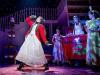
For it certainly is a spectacular piece of theatre. There is no denying that the selling point of this production is its highly impressive staging, using an expertly-orchestrated combination of lighting effects, projected pencil-drawn animation, large props used sparingly for maximum effect, and a supple, robust approach to its stagecraft that achieves a sense of immersive verisimilitude without ever striving for slavish realism.
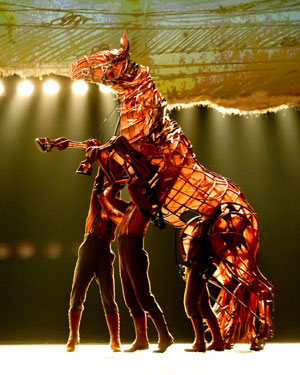
This ethos is most fully seen through the realisation of the title role, the starring character, which is also the key attraction. “Puppetry” doesn’t quite do justice to the effect of these huge, life-sized horses that take three operators to bring to life and are nuanced enough to deliver quite astonishingly believable performances. Capable of being literally ridden by other actors and emoting with enormous subtlety of movement, these horses, especially the “star” equine Joey, are quite a sight to behold, even from our distant perch in the precarious press seats in the uppermost circle.
The aesthetic of their construction is quite fascinating, as they are highly intricate yet unapologetically artificial, the practical detail of their armature undisguised. They are given a “skin” of sorts and an expressive mane and tail, but no seamless faux-hide to make the horse appear superficially lifelike. One wonders if somewhere early in the design process there had been an intent to strive for such surface realism only to abandon it upon the realisation of facing the catch-22 of “the uncanny valley”, a problem encountered by digital animators and makers of robots, whereby the harder you try to make something look externally believable, the more inexplicably creepy it becomes. One suspects that someone had the brainwave that if the horses were made to look unmistakably artificial at first glance, the audience’s focus would be drawn away from trying to decode how the effect was achieved and concentrate instead on the extraordinary nature of the actual performances these puppets were capable of giving.
Which is, frankly, remarkable. From the bucolic scenes of the better part of act one in which the horse is the object of interpersonal conflict, to its participation in the traumatising grander conflict on the shell-pocked fields of France, one is drawn into the virtuosic skill that goes into providing a clearly identifiable personality in this character. And Joey is exactly that, a character. For as good as the strong ensemble of flesh-and-blood actors is, and despite whatever shortcomings the wider narrative may have, it is the emotive capacity of this horse’s performance that is the most remarkable, and anyone with the least empathy for animals will become quite emotionally attached to this creature’s plight.
War Horse may not be appropriate for everyone, but I certainly recommend it to those who have a sense of pathos and wonder that is simpatico with this show’s particular vision of The Great War, one that is both harsh and sentimental, ignoble yet quietly heroic.
The National Theatre of Great Britain and Global Creatures present
War Horse
based on the book by Michael Morpurgo | adapted for the stage by Nick Stafford
Director Drew Barr
Venue: Lyric Theatre, Sydney
Dates: 16 March – 30 June 2013
Bookings: www.ticketmaster.com.au
Visit: www.warhorseaustralia.com